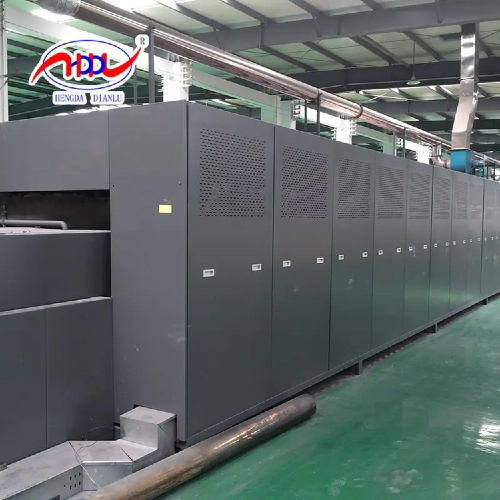
1. Understanding the Importance of Furnace Components
Aluminum brazing has become a cornerstone process in modern manufacturing, particularly in industries such as automotive, electric vehicles (EVs), aerospace, and HVAC systems. Aluminum's lightweight, corrosion-resistant, and thermally conductive properties make it ideal for components like radiators, condensers, heat exchangers, and cooling plates. However, achieving efficient, high-quality brazing requires precise control over furnace conditions, as even minor inconsistencies in temperature, atmosphere, or material handling can lead to defects, reduced joint strength, or material deformation.
The NB Continuous Cellular Board Brazing Furnace addresses these challenges through a combination of advanced components that collectively ensure uniform heating, optimal thermal management, and continuous operation. Each component is specifically engineered to maximize efficiency, improve quality, and reduce operational costs. Understanding these components allows manufacturers to fully appreciate how the furnace achieves superior performance in aluminum brazing.
This article explores each key component of the NB Continuous Furnace, highlighting its function, benefits, and contribution to overall operational efficiency. By understanding the roles of these components, manufacturers can make informed decisions to optimize their brazing lines and maintain consistent, high-quality production standards.
2. Continuous Conveyor System
2.1 Overview of the Conveyor System
The continuous conveyor system is the backbone of the NB Continuous Cellular Board Brazing Furnace. Unlike batch furnaces that require intermittent cycles for loading, heating, and unloading, this conveyor allows steady, uninterrupted movement of aluminum components through the furnace. The conveyor is constructed from high-strength, heat-resistant materials capable of supporting heavy aluminum assemblies without deformation, even under prolonged high-temperature exposure.
The precise engineering of the conveyor ensures consistent travel speed, which is crucial for controlling residence time in each heating zone. Uniform movement prevents uneven exposure, which is often a source of hot spots or under-brazed areas in aluminum components.
2.2 Benefits of Continuous Operation
Minimized Downtime: Continuous movement eliminates delays caused by batch transitions, allowing the furnace to operate 24/7 if required.
Uniform Exposure: Components remain in a steady thermal environment, ensuring consistent heating and cooling.
Optimized Workflow: Reduces manual intervention, streamlines production processes, and lowers labor requirements.
Enhanced Production Flexibility: The conveyor can accommodate varying component sizes and thicknesses without compromising quality.
2.3 Technical Considerations
Key considerations for the conveyor system include:
Load-Bearing Capacity: Ensures safe transport of heavy or irregularly shaped components.
Temperature Resistance: Materials must withstand prolonged exposure to high temperatures without losing structural integrity.
Speed Adjustability: Allows operators to fine-tune the residence time based on component specifications and brazing profiles.
The continuous conveyor is essential for achieving high-volume production while maintaining consistent quality across all components. Its integration with other furnace components ensures seamless operation and optimal thermal efficiency.
3. Cellular Board Heating Structure
3.1 Introduction to Cellular Board Design
The cellular board heating structure is a defining feature of the NB Continuous Furnace. These boards are heat-conductive panels arranged in a cellular pattern throughout the furnace, designed to distribute heat evenly across aluminum components. This structure minimizes temperature gradients that could otherwise lead to hotspots, warping, or incomplete brazing.
3.2 Advantages of Cellular Board Heating
Uniform Heat Distribution: Every surface of the aluminum component reaches the target brazing temperature simultaneously.
Reduced Material Deformation: Thermal stress is minimized, particularly for thin sheets or intricate component geometries.
Enhanced Joint Strength: Consistent heating promotes complete alloy bonding, ensuring strong and reliable brazed joints.
Energy Efficiency: Optimized heat transfer reduces energy consumption per unit of production.
Longer Furnace Life: Even heat distribution prevents localized overheating, extending the life of internal components.
3.3 Operational Insights
The cellular board design allows for precise thermal management in combination with multi-zone temperature control. By maintaining a stable temperature profile, the furnace can process various aluminum alloys and component thicknesses while preventing defects. The boards are also engineered for durability and low thermal mass to respond quickly to temperature adjustments, enhancing process control and energy efficiency.
4. Multi-Zone Temperature Control
4.1 Overview
Temperature control is critical for high-quality aluminum brazing. The NB Continuous Furnace employs a multi-zone heating system, where each zone can be independently adjusted to meet the specific thermal requirements of the components. This feature ensures precise heating profiles, reduces the risk of warping, and guarantees uniform brazing.
4.2 Functionality and Benefits
Independent Zone Control: Each zone has dedicated temperature sensors and controllers for accurate management.
Optimized Heating Profiles: Gradual heating, peak temperature holding, and controlled cooling prevent thermal shock and material stress.
Cycle Time Reduction: Efficient temperature management shortens the overall brazing process without compromising quality.
Enhanced Product Consistency: Each component receives a reproducible heat treatment, ensuring uniform performance across production batches.
4.3 Technical Features
PID controllers for precise temperature regulation
High-precision thermocouples for accurate real-time measurement
Feedback loops that automatically adjust heating elements based on live temperature data
This system allows manufacturers to fine-tune the brazing process for different alloys and geometries, providing flexibility and precision that batch furnaces cannot achieve.
5. Protective Atmosphere System
5.1 Importance of a Controlled Atmosphere
Aluminum is highly reactive at brazing temperatures, and exposure to oxygen can form oxide layers that weaken joints and degrade surface quality. The NB Continuous Furnace incorporates a protective atmosphere system, using nitrogen or hydrogen to maintain a stable, oxygen-free environment during the brazing process.
5.2 Benefits
Oxidation Prevention: Ensures clean, strong brazed joints.
Extended Furnace Component Life: Reduces corrosion of internal parts, such as heating elements and insulation.
Reduced Post-Processing: Clean brazed surfaces minimize the need for additional finishing or cleaning.
Process Reliability: Stable atmosphere conditions ensure consistent quality for every component.
5.3 Operational Insights
The protective atmosphere system is integrated with real-time monitoring to maintain optimal gas composition and flow. Automation allows the system to dynamically adjust to changing production conditions, ensuring consistent protection and performance across all components.
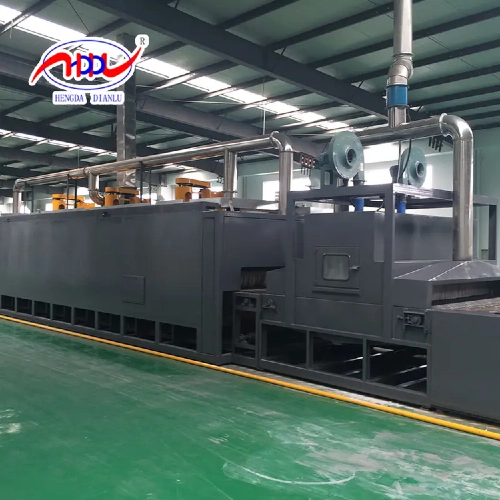
6. Automation and Monitoring Systems
6.1 PLC-Based Control
Modern NB Continuous Furnaces feature Programmable Logic Controller (PLC) systems for real-time monitoring and automation. The PLC controls conveyor speed, heating zones, and protective atmosphere, ensuring stable and repeatable operation.
6.2 Advantages of Automation
Consistent Quality: Reduces variability caused by manual operation.
Operational Efficiency: Optimizes furnace parameters to minimize energy consumption.
Predictive Maintenance: Data monitoring enables preemptive maintenance, reducing downtime.
Comprehensive Data Logging: Provides detailed records for quality control, process optimization, and traceability.
Remote Monitoring Capability: Allows operators to supervise furnace conditions and adjust parameters without interrupting production.
Automation is essential for achieving high-quality, energy-efficient, and reliable brazing in continuous production environments.
7. Auxiliary Components and Safety Features
7.1 Auxiliary Components
Auxiliary systems support the core functions of the furnace and ensure reliable operation:
Insulation: Maintains heat within the furnace, improving energy efficiency and reducing heat loss.
Heating Elements: Designed for durability and uniform energy delivery.
Structural Frames: Provide mechanical stability and support for all internal components.
7.2 Safety Features
Safety is a key consideration in industrial furnace design:
Interlocks and Emergency Stops: Prevent accidents and protect operators.
Temperature and Gas Alarms: Detect deviations to prevent process failures.
Overload and Overheat Protections: Safeguard both furnace and components during operation.
These systems ensure operational reliability, energy efficiency, and personnel safety, which are crucial in high-temperature, high-throughput aluminum brazing.
8. Efficiency Comparison Table
Component/System | Function | Key Benefits |
Continuous Conveyor | Material transport | High throughput, uniform heating |
Cellular Board Heating | Heat distribution | Reduced defects, consistent joints |
Multi-Zone Control | Temperature precision | Optimized cycle time, flexible processing |
Protective Atmosphere | Oxidation prevention | Clean joints, extended component life |
Automation & Monitoring | Process control | Reduced error, predictive maintenance |
Auxiliary & Safety | Support & protection | Energy efficiency, operator safety |
This table summarizes how each key component contributes to efficiency, quality, and reliability of the NB Continuous Cellular Board Brazing Furnace.
9. Conclusion
The NB Continuous Cellular Board Brazing Furnace combines multiple advanced components to maximize aluminum brazing efficiency and quality. Its continuous conveyor ensures stable material flow, cellular boards provide uniform heating, multi-zone controls deliver precise temperature management, and the protective atmosphere prevents oxidation. Along with automation, monitoring, and robust auxiliary and safety systems, this furnace offers a comprehensive solution for modern aluminum brazing operations.
For manufacturers aiming to increase throughput, reduce energy consumption, and achieve consistently defect-free results, understanding these key components is essential. To explore how the NB Continuous Furnace can optimize your production line or discuss tailored solutions, consider reaching out to the experts at Hengda Furnace Industry Co., Ltd., who can provide professional guidance and support to help you enhance efficiency and maintain high-quality standards in aluminum manufacturing.
10. FAQs
Q1: Why is the cellular board heating structure critical for aluminum brazing?
A1: It ensures uniform heat distribution, minimizing hotspots and material deformation, resulting in stronger, defect-free joints.
Q2: How does multi-zone temperature control improve efficiency?
A2: Independent control of each zone enables precise heating profiles, reducing cycle time while ensuring consistent quality.
Q3: What is the role of the protective atmosphere system?
A3: Nitrogen or hydrogen atmospheres prevent oxidation, ensuring clean brazed joints and extending furnace life.
Q4: How does automation contribute to furnace performance?
A4: Automated monitoring and control optimize temperature, conveyor speed, and gas flow, reducing human error and ensuring reproducible results.
Q5: Are auxiliary components important for operational efficiency?
A5: Yes, proper insulation, heating elements, structural support, and safety systems maintain energy efficiency, reliability, and operator safety.
Q6: Can the NB Continuous Furnace handle different aluminum alloys and component sizes?
A6: Yes, the combination of multi-zone control, cellular board design, and adjustable conveyor allows processing of a wide range of aluminum components.