1. Understanding the Importance of EV Battery Cooling Plates
Electric vehicles (EVs) are rapidly becoming the future of transportation, driven by the need for sustainable mobility and reduced carbon emissions. At the heart of every EV lies the battery system, which not only powers the vehicle but also requires meticulous thermal management to ensure safety, efficiency, and longevity. Effective heat dissipation is critical because overheating can significantly reduce battery life, compromise performance, and even pose safety risks.
EV battery cooling plates play a central role in managing temperature. These plates, typically made from aluminum due to its superior thermal conductivity, are designed to evenly distribute heat across battery cells, maintaining an optimal operating temperature during charge and discharge cycles. Manufacturing these cooling plates with high precision is essential; even minor defects in brazing can result in poor thermal performance, leakage, or mechanical failure.
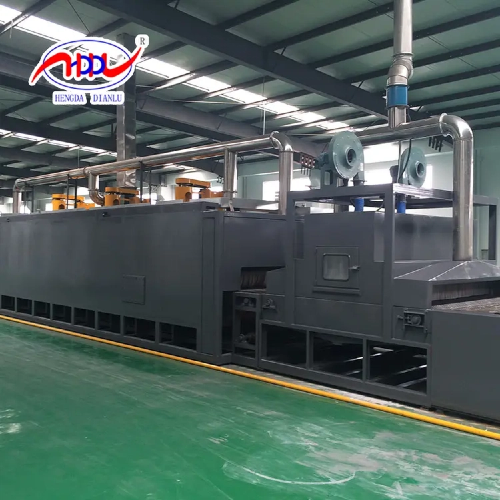
This is where the NB Continuous Cellular Board Brazing Furnace demonstrates its significance. Designed for high-precision aluminum brazing, this furnace ensures uniform heating, controlled atmosphere, and consistent quality across every cooling plate, making it a critical technology in modern EV battery production.
2. Aluminum Brazing in EV Battery Cooling Plates
2.1 Why Aluminum is Preferred
Aluminum is widely used in EV battery cooling plates due to its:
High Thermal Conductivity: Quickly dissipates heat from battery cells, preventing hotspots.
Lightweight Nature: Reduces overall vehicle weight, enhancing energy efficiency.
Corrosion Resistance: Ensures longevity in diverse operating environments.
Malleability: Facilitates complex cooling plate designs for optimized thermal performance.
2.2 Importance of Uniform Brazing
In the manufacturing of cooling plates, the brazing process joins aluminum components to create sealed channels for coolant flow. Uniform brazing ensures:
Consistent thermal conductivity across the plate
Mechanical stability and resistance to pressure
Minimization of leaks or defects
Compliance with strict EV battery safety standards
2.3 Challenges with Traditional Batch Furnaces
Traditional batch furnaces face several limitations:
Uneven heating can lead to hot spots or incomplete brazing
Frequent loading and unloading increases cycle time and labor costs
Limited automation and control reduce reproducibility
Inconsistent joint quality can result in higher rejection rates
The NB Continuous Cellular Board Brazing Furnace addresses these challenges through advanced continuous operation, precise temperature control, and a protective atmosphere system.
3. Continuous Conveyor System for High-Volume Production
3.1 Overview of Continuous Operation
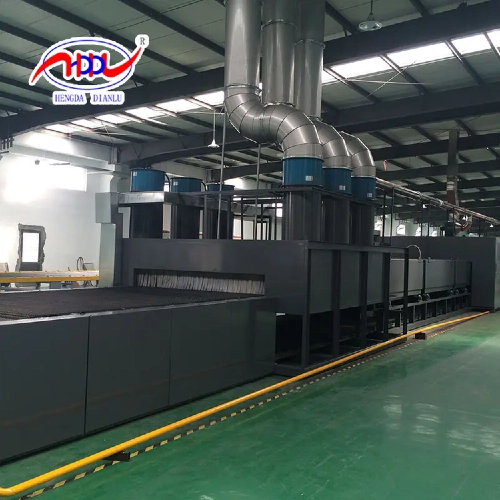
The continuous conveyor system is the backbone of the NB Continuous Furnace. It allows cooling plates to move steadily through different heating zones, eliminating the downtime associated with batch processing.
This system is engineered from heat-resistant, high-strength materials capable of supporting plates without deformation. Conveyor speed is adjustable, enabling precise control over residence time in each zone to match specific cooling plate designs.
3.2 Benefits in EV Cooling Plate Production
High Throughput: Continuous feeding increases production volume without compromising quality.
Consistent Heating: Ensures uniform exposure to heat, preventing hot spots.
Reduced Cycle Times: Accelerates manufacturing processes, improving efficiency.
Scalable Production: Ideal for mass production of EV battery components.
3.3 Technical Features
Adjustable speed controls for different plate sizes
Load-bearing rollers or belts designed for prolonged high-temperature exposure
Seamless integration with automation and monitoring systems
4. Cellular Board Heating Structure for Uniform Brazing
4.1 Design and Functionality
The cellular board heating structure is a unique feature that provides even heat distribution throughout the furnace. Each board is arranged in a cellular pattern to ensure all surfaces of aluminum cooling plates reach the required brazing temperature simultaneously.
4.2 Advantages for EV Cooling Plates
Elimination of Hot Spots: Prevents localized overheating that can weaken joints.
Reduced Warping: Maintains structural integrity of thin or intricate plate designs.
Enhanced Joint Strength: Promotes complete alloy bonding for superior performance.
Energy Efficiency: Optimal heat transfer reduces energy consumption per unit.
4.3 Operational Insights
The cellular boards are engineered with low thermal mass for rapid temperature adjustment. This allows the furnace to accommodate different alloys and plate thicknesses without sacrificing brazing quality.
5. Multi-Zone Temperature Control for Precision
5.1 Overview
Accurate temperature control is critical for aluminum brazing. The NB Continuous Furnace features a multi-zone system, where each zone is independently controlled to maintain precise thermal profiles.
5.2 Benefits
Precise Heat Management: Ensures consistent brazing across all cooling plates.
Minimized Defects: Reduces warping, cracking, or incomplete bonding.
Cycle Time Optimization: Accelerates production while maintaining high-quality output.
5.3 Technical Features
High-precision thermocouples for real-time monitoring
PID controllers for each heating zone
Automated feedback loops to maintain optimal temperatures
By leveraging multi-zone control, manufacturers can process various designs and aluminum alloys with consistent results.
6. Protective Atmosphere System for Oxidation Prevention
6.1 Importance of Controlled Atmosphere
Aluminum reacts readily with oxygen at brazing temperatures, forming oxides that reduce joint strength. The NB Continuous Furnace uses nitrogen or hydrogen atmospheres to prevent oxidation, ensuring clean and strong joints.
6.2 Benefits for EV Cooling Plates
Improved Joint Quality: Oxidation-free surfaces ensure strong, reliable connections.
Reduced Post-Processing: Minimizes cleaning and rework.
Extended Furnace Lifespan: Protects internal components from corrosion.
Process Reliability: Consistent protective environment ensures reproducibility.
6.3 Operational Considerations
The protective atmosphere system is monitored continuously to maintain gas flow and composition. Automated adjustments guarantee optimal protection throughout production.
7. Automation and Monitoring Systems
7.1 PLC-Based Control
The furnace integrates Programmable Logic Controllers (PLC) for full automation. This system manages conveyor speed, heating zones, and protective atmosphere to maintain precise process conditions.
7.2 Advantages
Consistent Results: Reduces variability caused by manual operation.
Enhanced Efficiency: Optimizes furnace performance and energy use.
Predictive Maintenance: Data monitoring allows early detection of potential issues.
Data Logging: Provides traceable records for quality control and compliance.
Automation ensures repeatable, high-quality brazing, essential for EV battery cooling plate production.
8. Auxiliary Components and Safety Features
8.1 Supporting Components
Insulation: Retains heat for energy efficiency.
Heating Elements: Durable and uniform energy delivery.
Structural Frames: Maintain mechanical stability and support internal components.
8.2 Safety Systems
Emergency stop mechanisms and interlocks
Temperature and gas flow alarms
Overheat and overload protection
These features ensure safe operation, energy efficiency, and reliable performance.
9. Integration and Benefits in EV Cooling Plate Manufacturing
The combination of all key components in the NB Continuous Furnace provides:
High-Quality Brazing: Uniform heating, precise temperature control, and oxidation prevention ensure defect-free joints.
Efficiency and Throughput: Continuous operation and automated monitoring reduce cycle times and labor requirements.
Energy Savings: Optimized heat transfer and insulation lower energy consumption.
Scalability: Supports mass production of EV battery cooling plates.
Competitive Advantage: Manufacturers can meet growing EV demand with consistent quality and cost efficiency.
10. Efficiency Comparison Table
Component/System | Function | Key Benefits |
Continuous Conveyor | Material transport | High throughput, consistent exposure |
Cellular Board Heating | Uniform heat distribution | Reduced defects, minimized warping |
Multi-Zone Temperature Control | Precise temperature management | Optimized cycle time, consistent brazing |
Protective Atmosphere | Oxidation prevention | Clean joints, minimal post-processing |
Automation & Monitoring | Process control | Reduced errors, predictive maintenance |
Auxiliary & Safety | Support & protection | Energy efficiency, operator safety |
This table illustrates how the integration of each component enhances EV cooling plate production efficiency, quality, and reliability.
11. Conclusion
The NB Continuous Cellular Board Brazing Furnace plays a crucial role in the manufacturing of EV battery cooling plates, combining multiple advanced components to achieve unmatched precision and efficiency. Its continuous conveyor system ensures smooth and uninterrupted movement of aluminum components, while the cellular board heating structure provides uniform temperature distribution across all parts. Multi-zone temperature control allows for precise thermal management tailored to different aluminum alloys and plate designs, ensuring defect-free, high-strength brazed joints. The integrated protective atmosphere system prevents oxidation, maintaining surface quality and reducing post-processing requirements. Coupled with automation and real-time monitoring, the furnace guarantees consistent production results, energy efficiency, and operational safety.
For manufacturers seeking to enhance throughput, reduce operational costs, and produce high-quality, reliable EV battery cooling plates, understanding the capabilities of the NB Continuous Furnace is essential. By leveraging this integrated furnace technology, companies can stay competitive in the rapidly growing EV market while ensuring that every cooling plate meets stringent performance and quality standards. To learn more about how the NB Continuous Cellular Board Brazing Furnace can optimize your production line, or to explore tailored solutions, consider contacting the experts at Hengda Furnace Industry Co., Ltd., who offer professional guidance and support for efficient, high-quality aluminum brazing operations.
12. FAQs
Q1: Why is the NB Continuous Furnace preferred for EV cooling plate manufacturing?
A1: Its continuous operation, uniform heating, and precise temperature control ensure high-quality, defect-free brazed joints.
Q2: How does the cellular board structure improve brazing quality?
A2: It distributes heat evenly, preventing hotspots, warping, and thermal stress in aluminum plates.
Q3: What role does the protective atmosphere play?
A3: It prevents oxidation, ensuring clean joints and reducing post-processing requirements.
Q4: Can the furnace handle different plate designs and aluminum alloys?
A4: Yes, multi-zone temperature control and adjustable conveyor speed provide flexibility for various designs and materials.
Q5: How does automation enhance production efficiency?
A5: PLC control and monitoring reduce human error, allow predictive maintenance, and ensure consistent quality.
Q6: What are the main benefits for EV battery cooling plate manufacturers?
A6: Increased throughput, energy efficiency, defect-free joints, and scalable, high-quality production.