1. Why the Choice of Brazing Equipment Matters
In modern manufacturing, high-quality aluminum brazing plays a pivotal role in ensuring the performance, reliability, and safety of components used in critical industries such as automotive, electric vehicles (EVs), HVAC, and other industrial applications. Components like EV battery cooling plates, heat exchangers, and industrial aluminum assemblies require precision brazing not only to maintain structural integrity but also to achieve optimal thermal conductivity and mechanical strength.
Traditional brazing equipment, including batch furnaces and pit or retort systems, has served manufacturers for decades. However, these methods often struggle to maintain uniform heating, minimize defects, and optimize throughput. They also tend to consume higher energy and labor resources, creating challenges in cost management and scalability.
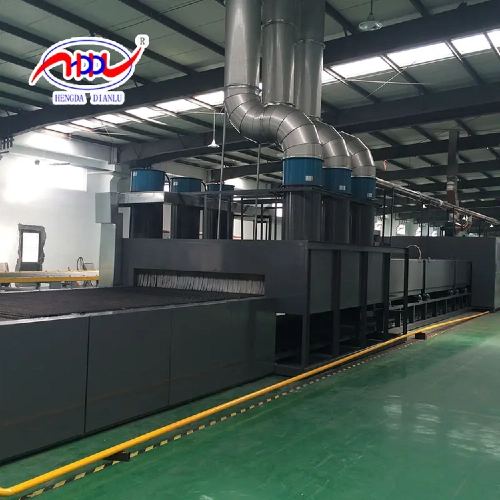
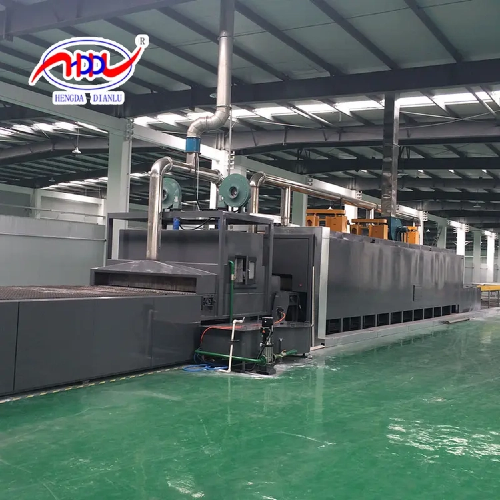
The NB Continuous Cellular Board Brazing Furnace represents a technological advancement in aluminum brazing. By integrating continuous operation, cellular board heating, multi-zone temperature control, a protective atmosphere, and automation, it enables manufacturers to achieve superior brazing quality, operational efficiency, and energy savings. Understanding the distinctions between this modern system and traditional equipment is essential for manufacturers seeking to enhance production efficiency and maintain competitive advantage in today’s fast-growing industrial markets.
2. Overview of Traditional Brazing Equipment
2.1 Batch Furnaces
Batch furnaces are widely used due to their simplicity and relatively low initial investment. These systems process a fixed number of components per cycle, requiring manual loading, heating, cooling, and unloading.
Limitations of Batch Furnaces:
Inconsistent Heating: Single-zone heating often creates temperature variations, causing weak or uneven brazed joints.
Long Cycle Times: Each batch must undergo a full heating and cooling sequence, reducing overall production efficiency.
High Labor Costs: Manual handling and monitoring increase operational demands.
Energy Inefficiency: Extended heating cycles and repeated furnace usage consume more energy per component.
Limited Flexibility: Adjusting for different component sizes or materials often requires significant manual intervention, reducing adaptability.
2.2 Pit or Retort Furnaces
Pit or retort furnaces are typically employed for small-scale production or specialized components. However, they also present challenges:
Lower throughput due to batch operation and single-loading mechanisms
Reduced precision in temperature control across all components
Higher oxidation risk if protective atmospheres are not implemented
Increased potential for defects, requiring additional inspection and processing
These constraints illustrate the need for a more advanced brazing solution capable of handling high-volume production while maintaining consistent quality standards.
3. Key Features of NB Continuous Cellular Board Brazing Furnace
The NB Continuous Cellular Board Brazing Furnace incorporates multiple advanced technologies designed to overcome the limitations of traditional equipment, enhancing both efficiency and quality in aluminum brazing.
3.1 Continuous Conveyor System
The furnace employs a continuous conveyor system that transports aluminum components smoothly through multiple heating zones. This eliminates the downtime associated with batch processing and allows manufacturers to maintain a steady and controlled production flow. Conveyor speed can be precisely adjusted to ensure optimal residence time in each heating zone, accommodating various part thicknesses and designs.
Additional Considerations:
Facilitates uninterrupted production for high-volume operations
Reduces the need for manual handling, minimizing errors and safety risks
Integrates seamlessly with automated monitoring and control systems
3.2 Cellular Board Heating
The cellular board structure ensures uniform heat distribution across each aluminum component. Each cellular board functions as a thermal conductor, transferring heat efficiently and evenly, which prevents hotspots, cold zones, and potential thermal distortion. This results in strong, defect-free metallurgical bonds crucial for high-quality aluminum brazing.
Advantages Over Traditional Single-Zone Heating:
Eliminates uneven heating common in batch furnaces
Reduces thermal stress on components, decreasing warping and defects
Improves energy efficiency by optimizing heat transfer
3.3 Multi-Zone Temperature Control
The furnace is divided into multiple independent heating zones, each equipped with high-precision thermocouples and PID controllers. This allows manufacturers to tailor the thermal profile to suit different aluminum alloys, part geometries, or brazing requirements.
Operational Benefits:
Ensures thorough and consistent brazing across complex components
Minimizes rework due to uneven heating
Optimizes energy consumption by applying heat only where needed
3.4 Protective Atmosphere
The NB Continuous Furnace uses a controlled atmosphere, typically nitrogen or hydrogen, to prevent oxidation during the brazing process. Maintaining a clean and inert environment is essential for producing defect-free, high-strength joints and minimizing surface degradation.
Key Benefits:
Reduces post-processing requirements and cleaning operations
Extends component and furnace lifespan by minimizing corrosion
Ensures uniform quality and metallurgical integrity
3.5 Automation and Real-Time Monitoring
PLC-based automation manages the furnace’s operations, including conveyor speed, temperature zones, and atmosphere composition. Real-time monitoring allows for immediate adjustments, predictive maintenance, and consistent output.
Advantages:
Reduces human error in production processes
Enhances safety by minimizing operator exposure to high temperatures
Provides comprehensive data logging for quality control and compliance
4. Direct Comparison Between NB Furnace and Traditional Equipment
The table below summarizes key differences between the NB Continuous Cellular Board Brazing Furnace and conventional brazing systems:
Feature | NB Continuous Furnace | Traditional Brazing Equipment | Advantage |
Operation | Continuous conveyor | Batch or retort | Higher throughput, less downtime |
Heating | Cellular board, multi-zone | Single-zone | Uniform heating, reduced defects |
Atmosphere | Controlled protective gas | Ambient air | Oxidation prevention, minimal post-processing |
Automation | PLC-based, real-time monitoring | Manual control | Consistent quality, less labor |
Energy | Optimized efficiency | Higher energy use | Cost-effective and sustainable |
Scalability | Adjustable for multiple designs | Limited | Flexible for different product sizes |
4.1 Throughput
Continuous operation ensures uninterrupted production, allowing manufacturers to meet high-volume demands efficiently. Batch systems, in contrast, must stop and restart for each load, resulting in lower overall productivity.
4.2 Heating Uniformity
Cellular board heating and multi-zone control provide consistent temperatures across all components. Traditional single-zone systems often produce uneven heat, which can compromise brazing integrity.
4.3 Defect Rates
The controlled environment of the NB furnace significantly reduces defects caused by oxidation, warping, or weak joints. Batch and pit furnaces are more susceptible to variability due to less precise heating and exposure to ambient air.
4.4 Energy Consumption
Optimized thermal management in the NB furnace reduces energy consumption by ensuring heat is applied efficiently. Traditional systems often waste energy through extended cycles and uneven heat distribution.
4.5 Labor Requirements
Automation minimizes manual labor, while traditional furnaces require more personnel for loading, monitoring, and quality checks.
4.6 Flexibility & Scalability
The NB furnace can accommodate various part sizes, designs, and alloys, whereas traditional equipment is less adaptable, making large-scale production or design changes more challenging.
5. Operational Benefits of NB Continuous Furnace Over Traditional Systems
5.1 Faster Production Cycles
The continuous design reduces cycle time by maintaining a constant flow of components through the heating process.
5.2 Consistent, High-Quality Brazed Joints
Uniform heating and protective atmospheres ensure high-strength, defect-free connections on every component.
5.3 Reduced Scrap and Rework
Stable process parameters and controlled conditions minimize defects, decreasing waste and operational costs.
5.4 Energy Efficiency and Cost Reduction
Optimized heating zones, insulation, and automation reduce energy consumption, leading to lower overall production costs.
5.5 Improved Safety and Reduced Manual Errors
Automation reduces operator intervention, minimizing risks associated with manual handling and high-temperature environments.
6. Application Advantages in Modern Manufacturing
6.1 Automotive and EV Battery Cooling Plates
High-quality brazing ensures effective thermal management, supporting battery safety, longevity, and performance.
6.2 HVAC and Heat Exchanger Components
Precision brazing results in leak-free joints, maintaining system efficiency and reliability.
6.3 Industrial Aluminum Components
Consistent brazing guarantees structural integrity and functionality in industrial machinery and equipment.
7. Strategic Value for Manufacturers
Adopting the NB Continuous Cellular Board Brazing Furnace provides significant strategic advantages:
Competitive Edge: Ensures compliance with stringent quality standards.
Scalability: Supports growth and adaptation to various production volumes.
Operational Efficiency: Reduces energy, labor, and rework costs while maintaining high-quality output.
8. Conclusion
The NB Continuous Cellular Board Brazing Furnace provides a comprehensive solution for modern aluminum brazing, surpassing traditional batch and retort furnaces in every key aspect. Its advanced design ensures uniform heating, resulting in defect-free brazed joints, while the continuous operation and precise temperature control enable higher throughput and faster production cycles. By minimizing defects and reducing scrap rates, it delivers significant operational savings, and its energy-efficient design lowers production costs. Furthermore, the furnace offers exceptional flexibility, accommodating various aluminum alloys and part designs with consistent quality.
For manufacturers striving to enhance efficiency, maintain high-quality standards, and optimize aluminum brazing operations in high-volume production, the NB Continuous Cellular Board Brazing Furnace represents a strategic investment. Companies looking to explore this advanced technology, understand its full capabilities, or identify tailored solutions for their production lines are encouraged to contact the experts at Hengda Furnace Industry Co., Ltd. Their professional guidance ensures that every manufacturer can achieve reliable, high-quality brazing performance while maximizing productivity and cost-effectiveness.
9. FAQs
Q1: How does NB Continuous Furnace achieve higher throughput than traditional batch furnaces?
A1: Continuous conveyor operation eliminates downtime between batches, maintaining a steady production flow.
Q2: Why is heating uniformity better in NB Continuous Furnace?
A2: Cellular board heating and multi-zone control ensure even temperature distribution, preventing weak joints.
Q3: How does the protective atmosphere benefit brazing quality?
A3: It prevents oxidation, maintains clean surfaces, and reduces post-processing requirements.
Q4: Can NB Furnace handle different aluminum alloys and part designs?
A4: Yes, adjustable temperature zones and conveyor speed allow flexible production.
Q5: What operational cost savings can be expected compared to traditional equipment?
A5: Lower energy consumption, reduced labor, and minimized scrap lead to significant savings.
Q6: How does automation improve production consistency and safety?
A6: PLC control and real-time monitoring reduce human error, ensure consistent output, and enable predictive maintenance.